
I’ll never forget the afternoon my neighbor, Dave, watched me struggle up my own back steps with a tray of burgers, nearly face-planting on the top landing. It was humiliating. I had spent weeks picking out the perfect composite decking trends to make the space look modern, but I’d completely ignored the ergonomics of the climb. Every step felt like a lunge at the gym. My knees were screaming. I realized that my ‘weekend warrior’ DIY project had turned my backyard into a literal obstacle course. A deck is only as good as the journey you take to get onto it. It happens every summer; you’re excited to show off the grill, the weather is perfect, and then you hit that one step that feels just a little too high. Your foot catches, the tray wobbles, and suddenly the perfect afternoon feels like a physical therapy session. In my early days, I was so focused on the aesthetic of composite decking secrets that I forgot the basic physics of human movement. My own stairs had a rise that varied by nearly an inch from the bottom to the top. I thought nobody would notice. My knees noticed. My guests noticed. Even my dog hesitated at the top. The ‘rise’—that vertical space between treads—is the heartbeat of your deck’s usability. If it’s off, your whole outdoor experience is off. Today, we’re going to stop the thigh-burn. We will talk about why your stair rise is ruining your relaxation time and how you can actually fix it without losing your mind. [IMAGE_PLACEHOLDER]
Stop Treating Your Back Porch Like a Stairmaster
The problem usually boils down to one word: Rise. When I first started building, I made the classic rookie mistake of thinking a half-inch difference between steps wouldn’t be noticed. I was dead wrong. Our brains are incredibly tuned to rhythm. If one step is 7 inches and the next is 7.5, your body loses its muscle memory and you stumble. This isn’t just about comfort; it’s about safety. According to the National Safety Council, falls are a leading cause of non-fatal injuries in the home, and uneven stair geometry is a primary culprit. I’ve seen beautiful homes where the railing system was top-tier, but the stairs felt like a death trap because the stringers were cut poorly. You might need to look into the stringer notch hack for squeak-free deck stairs to ensure your foundation is solid before you even think about the finish.
Should You Actually Bother Fixing the Rise?
You might be thinking, ‘It’s just a few steps, I’ll just get used to it.’ Trust me, you won’t. Every time you carry a heavy tray or a child up those stairs, you’re risking a trip. Plus, if you ever plan to sell, a home inspector will flag inconsistent rises faster than you can say ‘escrow.’ We are going to dive into the math that makes a stair ‘natural’ to climb. We’ll look at why your deck stairs need more than two stringers to prevent that bouncy, unstable feeling that makes a workout feel even harder. Have you ever felt that ‘stutter-step’ on a set of stairs and wondered if it was just you? Drop a comment or reach out—I bet it’s your rise heights. Let’s get into the nitty-gritty of the math that will save your joints.
Calculate Your Total Rise Before You Cut a Single Board
To get the rise right, you first need the ‘Total Rise’—the distance from the top of the deck surface down to the ground or landing pad. I remember one July afternoon when I was so confident I just eyeball-measured from the bottom of the joist. Big mistake. I ended up with a bottom step that was three inches taller than the rest. It felt like stepping off a curb into a pothole. To avoid my blunder, use a straight board and a level to extend the deck height out over your landing spot. Once you have that measurement, divide it by 7—the golden standard for a comfortable rise. If your total rise is 35 inches, you need five steps. If it’s 38, you’ll need to divide that by 5 to get a 7.6-inch rise. Always keep your rise between 7 and 7.75 inches to stay within code and comfort. If you’re working on a slope, you might need the string line secret for perfectly level railing runs to help visualize the final height against your house foundation.
Stop Your Stairs from Sinking into the Mud
No matter how perfect your math is, those stairs will become a nightmare if the foundation shifts. I once built a beautiful set of stairs for a client in a low-lying area, and by the next spring, the bottom step had sunk four inches into the soft clay. Every step above it was now a tripping hazard. You must provide a solid landing, like a concrete pad or buried pavers. If you skip this, you will eventually need to learn how to stop your deck stairs from sinking into the grass after the damage is already done. A solid base ensures that the ‘rhythm’ of your stairs stays consistent for the life of the deck.
The Secret to a Rock Solid Stringer Layout
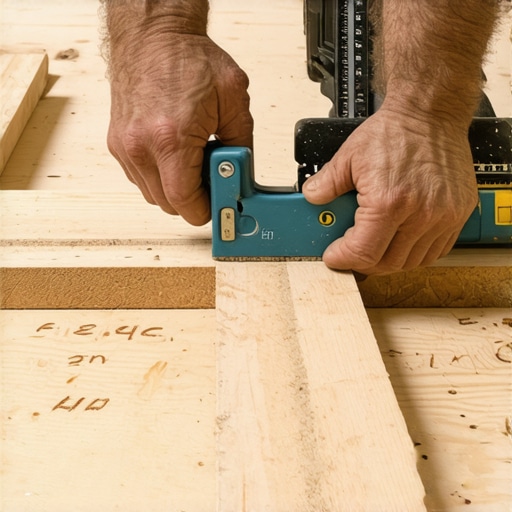
When you start layout out your stringers, you have to account for the thickness of your treads. If you’re using low-maintenance composite decking, remember that it might be thinner than a standard pressure-treated 2×12. If you don’t ‘drop the stringer’—meaning you cut the thickness of one tread off the bottom of the stringer—your bottom step will be too short and your top step will be too tall. It’s the most common mistake in deck building. I spent three hours once recutting a set of three stringers because I forgot this one simple rule. While you are at it, consider why your deck stairs need more than two stringers. Most people think two is enough, but a third or fourth stringer in the middle eliminates that ‘trampoline’ bounce that makes a staircase feel cheap and dangerous.
Eliminate the Squeak and the Bounce
A noisy staircase is a sign of a moving staircase. Friction between the tread and the stringer is what creates that annoying chirp every time you walk up. To fix this before it starts, I always recommend the stringer notch hack for squeak-free deck stairs. By slightly over-cutting or using specific adhesive techniques, you can lock those components together. If your stairs already feel soft, you are likely dealing with the structural reason your deck feels bouncy, which usually points back to insufficient support or wide spacing between stringers. Think of your stringers like the ribs of a ship; the more support you have, the more stable the journey will be. Once the structure is rigid, you can focus on the aesthetics, like choosing railing systems for safety and style that complement the rise and run of your new, comfortable climb.
Let’s dig deeper into what the glossy brochures won’t tell you. Everyone says composite is ‘set it and forget it,’ but in my experience, the surface is only half the battle. The biggest lie in the industry is that the substructure doesn’t need love once you cover it with plastic. According to the North American Deck and Railing Association (NADRA), the majority of deck failures happen from the inside out, often due to moisture trapped between the joist and the board. Even with low-maintenance composite decking, your frame is likely still pressure-treated lumber. This is precisely why pressure treated wood still needs maintenance under composite. If you don’t use the joist tape secret for doubling your decks lifespan, you’re essentially putting a 50-year top on a 15-year foundation. I’ve seen expensive decks ripped up because the joists rotted while the boards looked brand new.
Why do my mitered joints keep opening up?
This is the most common advanced-level frustration. You spend all day getting those 45-degree angles perfect, only for them to look like a canyon by January. This happens because composite boards expand and contract along their length much more than wood. If you didn’t follow the expansion gap rule that stops boards from buckling, the boards will literally push themselves apart. For those seamless corners, you need to use the pvc glue trick for gap-free composite miters to chemically bond the ends together. Have you ever fallen into this trap where your ‘perfect’ cuts changed over the seasons? Let me know in the comments.
The Hidden Danger of Dark Decking Colors
We all love the look of dark charcoal or deep mahogany, but here is the ‘oops’ factor nobody mentions until it’s 95 degrees out: heat absorption. Dark composite can reach temperatures over 150 degrees Fahrenheit, which is enough to cause discomfort for bare feet or pets. Beyond the burn, that heat is what drives the extreme movement that causes your hidden fasteners to pop up in heat. If your backyard is a sun-trap, you might be better off with lighter tones or specifically looking for materials where capped polymer composite stays cooler than wood plastic. The technical term for this movement is the coefficient of linear thermal expansion. While wood expands mostly in width, composite expands in length. If you use a rigid fastening system on a long board without accounting for this, the sheer force can actually snap the heads off your screws. This is often why your deck screws are snapping in cold weather. It’s not a product defect; it’s a physics problem. When you’re designing, you have to think like an engineer, not just a carpenter. If you are struggling with the layout, remember that you need a 3d model before buying a single deck board to visualize how these gaps and transitions will actually function. Finally, don’t assume that a dark railing is the best for your ‘view.’ A common mistake is thinking white railings look clean; in reality, your eye focuses on the white bars, whereas if you choose a railing color that doesnt block your view—like black or dark bronze—the railing ‘disappears’ into the landscape.
I’ve spent more money on tools than I care to admit to my wife, but three specific items changed my building life. First, throw away that cheap plastic drill guide. I use a heavy-duty jig for every single baluster. It’s the only way to avoid that annoying slanted look that happens when you’re tired on the 40th hole. This is where the drill guide hack for centered baluster holes becomes your best friend. Second, invest in a dedicated impact driver rather than a standard drill. The torque difference prevents the screw heads from stripping, which is a nightmare when you’re working with composite decking trends that feature harder capping layers. According to technical bulletins from Simpson Strong-Tie, specifically their DCA 6 – Prescriptive Residential Wood Deck Construction Guide, the way you attach your railing posts to the rim joist is the single most common point of structural failure. Don’t just toe-nail them. Use structural screws and the hidden bracket trick for perfectly rigid railing posts to ensure that your railing doesn’t start wobbling by year three.
How do I keep my deck looking brand new for a decade?
People often think low maintenance means no maintenance. That is a dangerous myth. You need to keep organic debris, like wet leaves and pine needles, out of the gaps between boards. If you don’t, you’ll end up needing how to stop moss from growing in the gaps of your deck because that trapped moisture creates a perfect greenhouse for rot and fungi. Also, for the love of your warranty, why you should never use bleach on your composite deck—the harsh chemicals can eat away at the protective UV-resistant cap of the board, leading to permanent discoloration. Instead, a simple soap and water scrub once a year is the real composite decking secrets for longevity. It’s about being proactive rather than reactive.
The Smart Deck Revolution is Coming
Looking ahead, the backyard is becoming as tech-integrated as the living room. I see a future where every pergola has integrated solar and automated shade sensors. We are already seeing how to install a ceiling fan on a freestanding pergola become a standard request rather than a luxury upgrade. We are moving toward decks that think for themselves, with the low voltage lighting trick for highlighting deck levels being tied to smart-home ecosystems. If you want to get ahead of the curve and give your project that high-end, custom-furniture look right now, I strongly recommend you try the counter-bore secret for seamless railing connections on your next build. It hides the fasteners completely and makes the whole structure look like it was carved from a single piece of material.
Hard Truths About Stair Geometry That Most Contractors Ignore
After years of fixing wobbly steps and tripping hazards, I’ve realized that the ‘spirit’ of a deck lives in the transition from the ground to the platform. If your eyes love the view but your knees hate the climb, the project is a failure. My lightbulb moment came when I stopped trying to force my stairs to fit the landscape and started making the landscape fit the stairs. This often means using the double rim joist secret for rock solid deck edges to ensure the stairs have a massive, unmoving anchor point. Another lesson? Never trust a ‘close enough’ measurement. If you are even a quarter-inch off on your stringer cuts, the human brain will detect the lack of rhythm, and someone will eventually stumble. If you’re planning for extra weight, like a gathering spot on a landing, make sure you know how to calculate footings for a hot tub on your deck even if it’s just for heavy planters, because stairs are the most common point of structural fatigue.
[IMAGE_PLACEHOLDER_E]
The Toolbox Essentials That Saved My Sanity
If you want to build like a pro, you need to stop guessing. My personal toolkit isn’t just about hammers and saws; it’s about the resources that prevent rework. I never start a layout without digital visualization; why you need a 3d model before buying a single deck board is a lesson I learned after wasting five expensive composite planks. For physical longevity, I swear by the joist tape secret for doubling your decks lifespan; it is the cheapest insurance policy you can buy. When it comes to the final assembly, I always rely on the hidden bracket trick for perfectly rigid railing posts to make sure the safety features of the stairs feel like an extension of the house itself. These tools turn a frustrating DIY weekend into a professional-grade transformation.
Claim Your Perfect Outdoor Sanctuary
Building your dream space is a journey, and while the technical details like rise and run might seem daunting, they are the foundation of your future relaxation. Don’t let the complexity of modern composite decking trends overwhelm you. Take it one step at a time, prioritize the structure over the shine, and you will create a backyard legacy that lasts for decades. Your knees, your guests, and your future self will thank you for the extra effort you put into the details today. Have you ever struggled with that ‘stutter-step’ feeling on a set of stairs where the rhythm felt just a little bit off? Let me know your stair-building stories in the comments below!